Prices are in local currency: Peruvian soles (S/); US$1 was about S/ 3.44 on November 23, 2026. Fees change, so check the official sites before you go.
The Qorikancha (also spelled Coricancha) has two separate entrances, and it’s worth knowing that before you arrive. The Qorikancha Site Museum (Museo de Sitio Qorikancha), under the esplanade on Avenida El Sol, is included in the Cusco Tourist Ticket (Boleto Turístico del Cusco): the Circuit II partial ticket costs S/ 70 for foreign visitors and S/ 40 for Peruvians and residents, according to the official COSITUC price list. The temple and convent of Santo Domingo is paid separately: it has no published official rate, and the latest reference is S/ 15 for adults and S/ 8 for students, with hours from Monday to Saturday 8:30 a.m. to 5:30 p.m. and Sundays 2 p.m. to 5 p.m. (Inca Rail, updated in December 2024).
Qorikancha Entrance Fee in 2026
Here’s what you pay for each part. The ticket prices are the current official ones; the temple prices are the latest dated reference we found.
| What you visit | Foreign visitor | Peruvian or resident | Source |
|---|---|---|---|
| Qorikancha Site Museum with Partial Ticket II (8 sites, 2 days) | S/ 70 | S/ 40 | COSITUC |
| Site Museum with the Full Ticket (16 sites, 10 days) | S/ 130 | S/ 70 | COSITUC |
| Full student ticket | S/ 70 | S/ 40 | COSITUC |
| Santo Domingo temple and convent (direct entry) | No published official rate; latest reference: S/ 15 adults, S/ 8 students | Inca Rail, Dec. 2024 | |
Three details about the ticket that will save you surprises, all from the COSITUC frequently asked questions:
- There’s no stand-alone ticket for the site museum. To get in there alone you buy the Circuit II partial ticket, which also includes the Regional Historical Museum, the Museum of Contemporary Art, the Museum of Popular Art, the Pachacuteq Monument, the Centro Qosqo de Arte Nativo, Tipón and Pikillaqta.
- You buy it in person, not online: at the ticket counter at Av. El Sol 103 (Galerías Turísticas), Monday to Sunday from 7:30 a.m. to 6 p.m., or at the sites on the ticket themselves.
- Children don’t pay up to age 9. From 10 to 17 they buy the student ticket with their ID; from 18 to 25, with a valid university ID or ISIC card.
The ticket carries your name and they ask for ID along with it, so it can’t be lent or resold.
Tourist Ticket or Stand-Alone Entry? Which One Suits You
It depends on how many days you have in the city. If you’re going to see Saqsayhuamán, the Sacred Valley and the museums, the S/ 130 full ticket works out better than adding up partial tickets, and the Qorikancha (the museum) is already included. I explain it with an itinerary in Cusco in 3 days.
If you only want the temple, the cloister and the Inca walls, which is what almost everyone pictures when they say “Qorikancha”, you don’t need the ticket: you pay the direct entry at the door of Santo Domingo. And if you’re interested in the archaeological part (the display cases with ceramics, metals and the scale models of the temple), that’s where the ticket comes in.
Hours and How Long to Spend
The temple and convent are open Monday to Saturday from 8:30 a.m. to 5:30 p.m. and Sundays from 2 p.m. to 5 p.m., according to the Inca Rail reference (December 2024). Since it’s a working convent, hours can change on religious holidays; if you go during Holy Week (Semana Santa) or on a Sunday, ask at the entrance.
In an hour and a half you can walk through the cloister, the Inca rooms and the view over the garden. If you add the site museum, count on another hour. COSITUC doesn’t publish the site museum’s hours on its website, so confirm them at the Avenida El Sol counter when you buy the ticket.
What to See at the Coricancha
It was the main Inca temple dedicated to Inti, the Sun god, and the Spanish built the convent of Santo Domingo on top of it (Wikipedia). That’s why what you see is an unusual mix: colonial arcades above and Inca walls below.
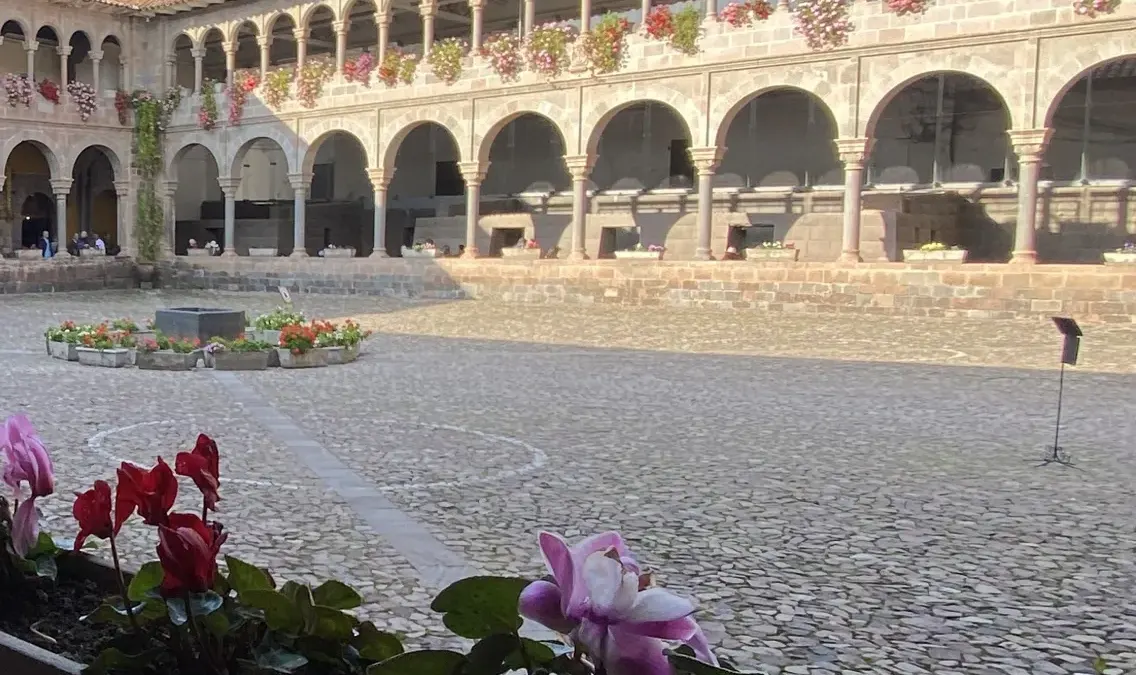
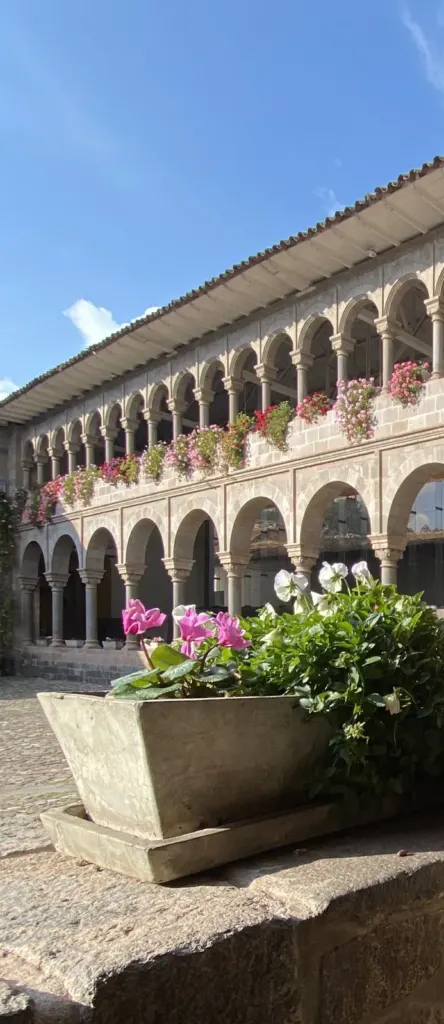
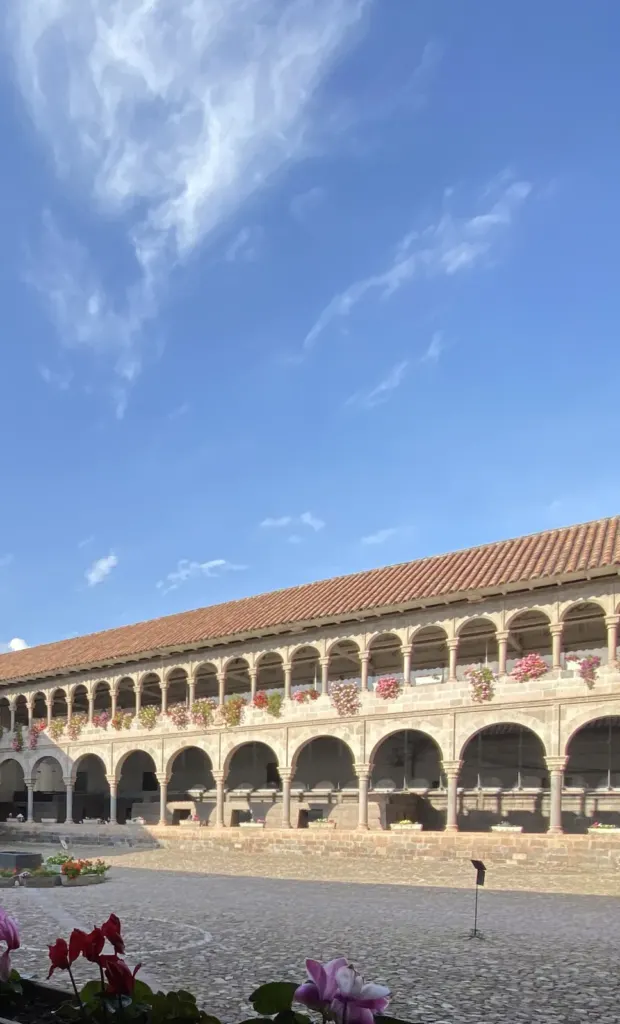
- The cloister: a huge courtyard with two floors of stone arches, a cobblestone floor and balconies full of flowers. It’s the part we photographed most.
- The Inca rooms: rooms of carved stone that are still standing. According to the same source, the Inca walls withstood the 1650 earthquake, which damaged the convent, and after the 1950 earthquake reconstruction began in 1956.
- The Site Museum: five rooms with objects found on the esplanade (ceramics, stone and metal pieces, trepanned skulls and mummies) and scale models of what the temple may have looked like at its peak, according to the COSITUC page for the museum.
How to Get to the Qorikancha
It’s in the historic center, on Avenida El Sol, a few blocks downhill from the Plaza de Armas. You can walk there from almost any hotel in the center. The tourist ticket counter (Av. El Sol 103) is on the same avenue, so you can buy it on the way.
If you’ve just arrived in Cusco and still feel the altitude, this is a good plan for the first day: it’s on foot and has almost no uphill stretches.
Tips for Your Visit
- Go in the morning. We went at 4 p.m. and the cloister galleries were already in shade.
- Bring cash in soles for the temple’s direct entry.
- If you’re buying the full ticket, do it the same day you start your visits: the validity period starts when you buy it (COSITUC).
- It’s a convent with active worship: wear discreet clothing and keep quiet in the church areas.
- Bring a cap and sunscreen: the courtyard is open and has almost no shade.
How It Fits Into Your Trip
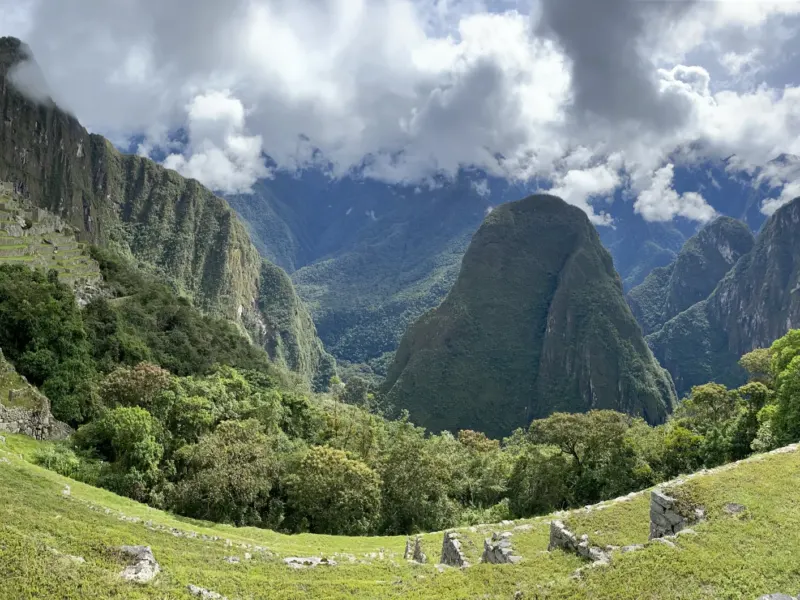
The Qorikancha works well on your first day in Cusco, while you acclimatize. The next day it’s time for the Sacred Valley and Ollantaytambo, and if you’re going to Machu Picchu, buy your Machu Picchu tickets well in advance.
How We Saw It
We went to the Qorikancha in March 2024. These photos are ours and they’re of the convent cloister; the prices and hours above are the current ones or the latest dated reference, not the ones from that trip.

Frequently Asked Questions
How much does it cost to enter the Qorikancha?
The temple and convent have no published official rate; the latest reference is S/ 15 for adults and S/ 8 for students (Inca Rail, December 2024). The Qorikancha Site Museum is included in the Cusco Tourist Ticket: S/ 70 for the Circuit II partial ticket or S/ 130 for the full ticket for foreign visitors (COSITUC).
Is the Qorikancha included in the tourist ticket?
Only the Qorikancha Site Museum, within Circuit II. The temple and convent of Santo Domingo is paid separately at the entrance.
What are the Qorikancha’s hours?
Monday to Saturday from 8:30 a.m. to 5:30 p.m. and Sundays from 2 p.m. to 5 p.m., according to Inca Rail (December 2024). They may change on religious holidays.
Can you buy the Cusco tourist ticket online?
No. You buy it in person at the counter at Av. El Sol 103, Monday to Sunday from 7:30 a.m. to 6 p.m., or at the included sites (COSITUC).
How much time do you need to visit the Qorikancha?
About an hour and a half for the temple and the cloister, and one more hour if you add the site museum.
Do children pay at the Qorikancha?
With the tourist ticket, children don’t pay up to age 9, and from 10 to 17 they buy the student ticket with their ID (COSITUC).
This English version is a translation of my Spanish guide, made with AI assistance and checked against the original for prices, hours, dates and links. Leer en español

José G.
José G. is a Peruvian traveler who lives in Mexico. Born in Lima and Mexican by adoption, he travels around Mexico and Latin America and writes about what he tries first-hand: where to eat, which museums are worth it, where to stay and what everything really costs. He loves good food, museums, soccer and traveling as a couple. He writes with real prices and honest opinions, and he does not recommend places he has not been to.
How I made this guide: I went in person, and the 3 photos credited “Photo: José G.” are mine. If something did not convince me, I say so.
Keep planning
Cusco Itinerary for 3 Days: Tourist Ticket and What to See
Machu Picchu Tickets 2026: Prices, Circuits and How to Buy